

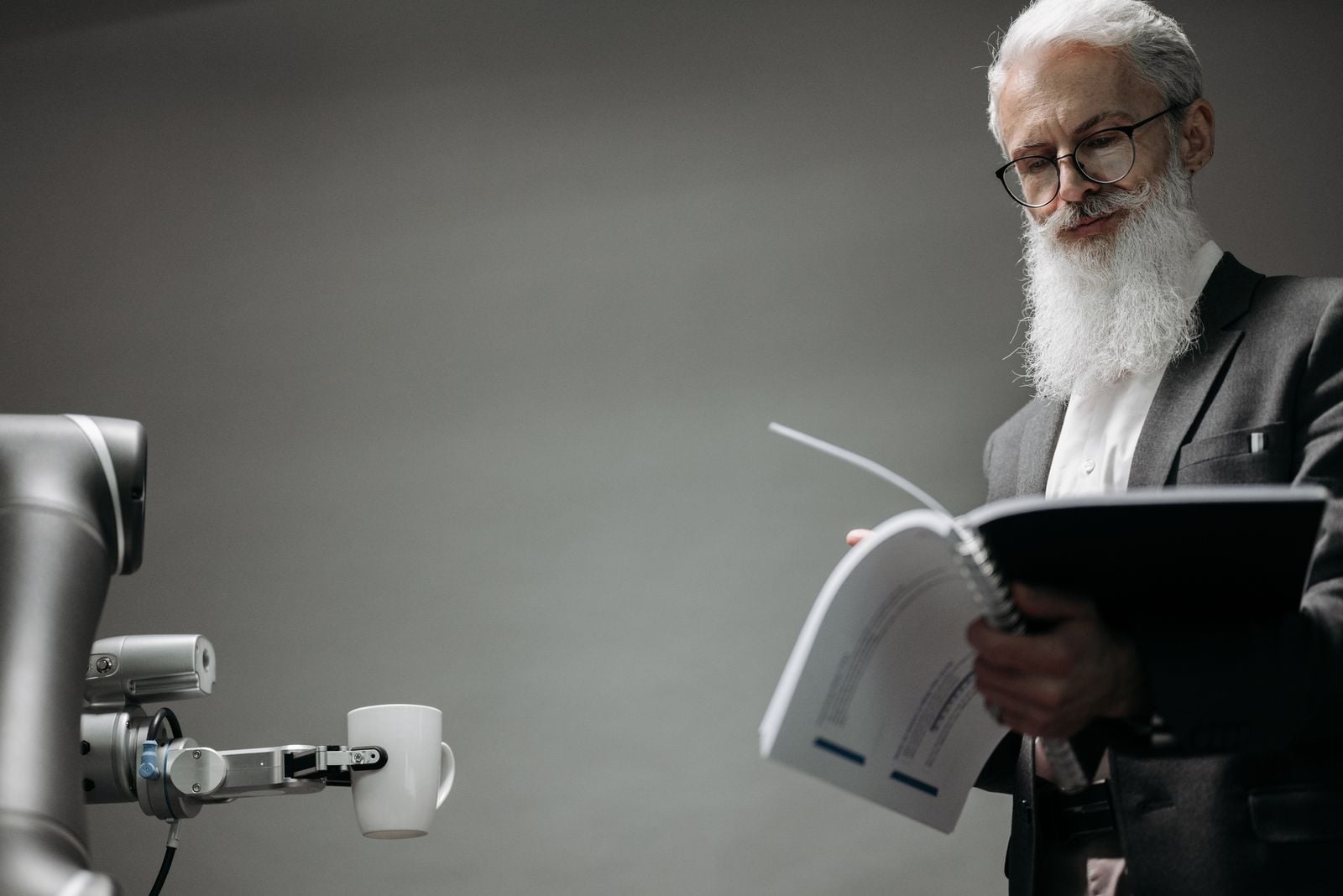
The old automation map was easy to picture. Machines would arrive first for repetitive factory work, while people paid to write code, interpret accounts or draft legal documents would remain protected by education and judgement.
Generative AI has made that map look dated. Professional work already happens in the environment these systems understand best: text, code, spreadsheets and searchable documents. A coding assistant can be deployed to thousands of people overnight. A broadly capable factory robot must perceive a changing physical space, move safely around people, manipulate varied objects and remain economical through long shifts.
This does not mean knowledge workers are being replaced at scale, or that factory automation has stalled. The evidence points to a narrower change in sequence. Parts of professional work are being compressed now, while general-purpose physical automation remains largely in pilots and narrow applications.
The older automation wave really did hit factories
Factory workers had good reasons to take automation seriously. In a widely cited study of US labour markets, Daron Acemoglu and Pascual Restrepo linked industrial robot adoption from 1990 to 2007 with lower employment and wages in the places most exposed. Their estimates did not describe every factory, but they documented a real displacement effect.
Industrial robotics is still expanding. The International Federation of Robotics recorded 542,000 installations in 2024, more than twice the annual number a decade earlier. These systems weld, paint, lift, inspect and move materials at high speed.
Yet their competence is usually narrow. The arm that places one part with millimetre precision is not a general factory worker. It succeeds because the cell, tooling, safety perimeter and workflow have been engineered around a defined task.
AI reaches work that is already digital
The current reversal is less about intelligence than deployment. Generative models operate directly on the symbolic material knowledge workers produce. Code can be tested. Documents can be searched. Reports can be compared. A bad draft can be corrected without a two-tonne machine colliding with anybody.
An ILO review published in April 2026 noted that older automation measures tended to place lower-skilled routine work at greatest risk, while newer capability measures put business, finance, computing and education among the most exposed fields. The ILO also warned that exposure is an early-warning signal, not a forecast of job losses.
Silicon Canals made a related point in an earlier article on why coding can be more reachable than truck driving. The decisive factor is not which job looks harder. It is which work has been recorded in a form a model can learn from and enter cheaply.
Developers show both productivity and hiring pressure
A 2026 Management Science study combined randomised trials at Microsoft, Accenture and a Fortune 100 company. Across 4,867 software developers, access to a coding assistant was associated with a 26.08 per cent increase in completed tasks. Less experienced developers adopted it more and recorded larger gains.
That is task compression in direct form. The same amount of developer time produced more completed work. The experiment does not reveal whether employers respond by shipping more, hiring fewer people or doing both.
Payroll evidence supplies a cautious warning. The August 2026 revision of Stanford’s Canaries working paper found no widespread economy-wide displacement. However, employment for workers aged 22 to 25 in highly AI-exposed occupations was 19 per cent below where it would have been had it kept pace with less-exposed peers. The gap appeared mainly through reduced hiring, and the authors described the result as an early descriptive indicator rather than a causal estimate.
Our earlier coverage of the first Stanford release focused on that entry-level split. The updated data make the pattern harder to dismiss, but not sufficient to blame every technology-sector hiring change on AI.
Finance and law reveal what compression means
A November 2025 working paper on financial analysts used FactSet’s release of its Mercury AI platform as a natural experiment. Analysts with access produced reports drawing on 40 per cent more distinct information sources, covering 34 per cent more topics and using 25 per cent more advanced analytical methods. Reports also arrived sooner.
There was a catch. Forecast errors rose by 59 per cent as the richer mix of information became harder to synthesise. AI compressed collection and drafting while leaving human judgement as a bottleneck, and sometimes burdening it with more material.
Legal work shows a similar shift near the bottom of a professional ladder. A 2026 study assigned 137 upper-level law students six realistic tasks designed with practising lawyers to resemble work given to junior associates. Access to a legal retrieval system or an AI reasoning model produced statistically significant gains in quality-adjusted productivity of roughly 50 to 130 per cent on five tasks.
The participants were students, not practising junior lawyers, and one transactional drafting task showed no significant improvement. Even so, faster memos, complaint analysis and persuasive letters raise a structural question for firms. The work being compressed is also the work through which juniors learn.
Factory robots are advanced but not yet general
None of this makes physical automation primitive. BMW says a Figure 02 humanoid completed about 1,250 operating hours at its Spartanburg plant, moving more than 90,000 sheet-metal components and supporting production of more than 30,000 vehicles. That is real factory work.
It was also one precise, repetitive placement task in an already highly automated body shop. BMW’s 2026 deployment of another humanoid in Leipzig remains a pilot. The IFR says industrial manufacturers are focusing humanoids on single-purpose tasks and that an economical, scalable case against existing automation has yet to be established.
“Years behind” is not a reliable countdown to a date when a general robot replaces a factory workforce. It describes the present deployment gap. Digital assistants are already inside the tools used by millions of professionals. Humanoids able to move freely between many factory jobs are still proving reliability, safety, dexterity, cycle time, energy use and maintenance cost.
The order changed before the outcome did
The strongest correction is not that office jobs will vanish before factory jobs. It is that professional status no longer provides the protection it once appeared to. Work becomes exposed when its component tasks are legible, repeatable and cheap to insert into software.
That still leaves most jobs as bundles of machine-friendly and human-dependent tasks. Our recent article on Google’s ATLAS study found that fewer than 10 per cent of observed conversations in heavily used cognitive work attempted end-to-end automation. Collaboration was far more common.
Collaboration can still shrink the hours needed for a memo, forecast or block of code. When that compression occurs in junior work, it can alter hiring without eliminating the occupation. Traditional robots changed factories one engineered cell at a time. Generative AI is beginning with fragments of professional work, and those fragments are already large enough to matter.